DEATH and LIFE
in the
CITY of DREAMS
Reader Resource
Some spoilers found within.
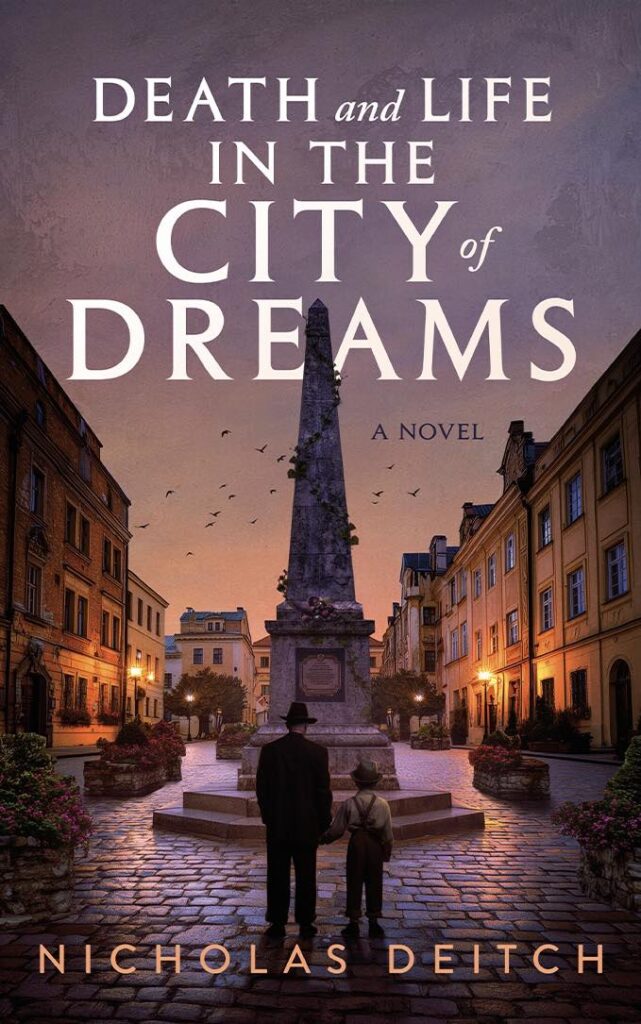
Synopsis
A city’s visionary founder reaches out across time to inspire a burned-out city planner to rise up against the politics of fear—to change his dying city’s destiny.
On a rise above the valley, burned-out city planner Townsend Meadows looks across the Evermore Valley in the falling light of dusk, the ghost of his dead friend, Fen, at his side.
“Do you ever wonder,” Fen asks, “what this city will look like five hundred years from now? Fifty decades, brother—and every step we take brings us a little closer to oblivion—or something wondrous.”
Death and Life in the City of Dreams is a sweeping work of literary fiction about the birth of a city, its faltering present, and the generations of people who struggle to shape what the city will become.
Set in the fictional City of Evermore, in the fertile Valley of Abundant Giving, somewhere in the American West, the novel moves between past and present across more than 150 years. What begins as a hopeful township grows into a thriving city, that gradually succumbs to the forces of modern sprawl—disconnected from the wisdom of the land, its history, and the ideals upon which the city was founded.
In the nineteenth century, the town’s visionary founder, Garrison Fischer, imagines a city that is more than streets, buildings, and parcels of land. He dreams of a city shaped by community, beauty, nature, and human connection—leaving behind a message for generations he will never know. Young architect Martin Tyler inherits something of that dream, even as the competing ambitions of the Tyler and Sloan families begin to shape
the valley in profoundly different ways.
More than a century later, Townsend has lost much of the idealism that first drew him to city planning, and now finds himself caught within a system thwarted by political expediency and the fear of change. As the city Struggles through environmental crisis and waves of sprawling development, Townsend begins to discover fragments of Garrison Fischer’s forgotten dream.
His search draws him to people separated by generations: ranchers and architects, artists and planners, developers and politicians—the prosperous and dispossessed. Among them is a homeless savant called Motorman, who discovers an extraordinary secret hidden within the atrophied heart of the city’s aging center.
As the pieces come together, Townsend discovers something larger still: that healing our cities—our communities, ourselves—begins when we embrace the courage to imagine a better future together, and take the steps that will begin to make it real.
From the orchards at the valley’s rim to the struggling heart of the aged downtown, Death and Life in the City of Dreams is a story of ambition and stewardship, corruption and hope, loss and rediscovery. Beneath this story lies a deceptively simple question:
What kind of city—and what kind of world—will we leave for those to come?
The Setting
The Evermore Valley
A lush and fertile valley in the western United States, inhabited for thousands of years before westbound settlers arrive in the mid-nineteenth century.
The Indigenous people know it as The Valley of Abundant Giving, a place where land, water, plants, animals, and human life have long existed in relationship with one another.
With settlement comes another way of seeing the valley: as property to be surveyed, divided, cultivated, developed, bought, and sold.
From this tension the City of Evermore is born.
Evermore is not based upon any single city. It is a composite of many American cities—and of the choices that have shaped them.
Principal Characters
The Founders
- Garrison Fischer
- Surveyor, visionary, and founder of the Evermore Township Company. Garrison dreams of creating not merely a successful town, but a beautiful and enduring community. His vision—and the message he leaves behind—reverberates through generations.
- Cora Fischer
- Garrison’s beloved wife, whose absence remains part of the emotional landscape of his life.
- Rachel Fischer
- Daughter of Garrison and Cora. A shopkeeper and suffragette, her life becomes intertwined with the Tyler family when she falls in love with Martin Tyler.
The Tyler Family
- Farnum Tyler
- A farmer who moves west in the 1860s from New Hampshire with his family and purchases the Fischer farmland.
- Sabra Tyler
- Farnum’s wife and matriarch of the early Tyler family.
- Martin Tyler
- Son of Farnum and Sabra. An idealistic young architect approaching the dawn of the twentieth century. Martin shares Garrison Fischer’s belief that buildings and cities can embody something greater than commerce or necessity.
- Georgie Tyler
- Daughter of Farnum and Sabra, sister of Martin.
- Cyrus Tyler
- The youngest son.
- Jake Tyler
- A later descendant and heir to the Tyler Ranch. City councilman and friend of Townsend Meadows.
- Jenny Tyler
- Jake’s wife. Expert in animal husbandry and roses.
- Matthew Tyler — “The Hoodie”
- Jake’s son, whose story becomes entwined with the contemporary struggle over Evermore’s future.
- Thatcher Goodman
- Architect and descendant of the Tyler family, carrying another generation of the family’s complicated relationship with the city.
The Sloan Family
- Hartford Sloan
- An early settler and partner in the Evermore Township Company, he is the son of a slave trader, and is deeply wounded. The Sloan family’s relationship to land and power develops along a markedly different path from that of the Tylers.
- Rebecca Sloan
- Hartford’s mail-order bride, who dies giving birth to their son, Josiah.
- Josiah Sloan
- Son of Hartford and Rebecca and father of Preston Sloan.
- Preston Sloan
- Developer and patriarch of the modern Sloan dynasty. His story culminates in violence in 1956, leaving consequences that echo through the lives of his descendants.
- Katherine Sloan
- Preston’s wife and mother of Jon Sloan, murdered in 1956
- Jon Sloan
- Heir to the Sloan estate. Beneath his inheritance of wealth and privilege lies another inheritance—loss, memory, and an unfinished love.
Alma and Her Family
- Alma Melendez Reyes
- Jon Sloan’s young love, whose life becomes inseparable from the hidden history of the Sloan family.
- Hector Reyes
- Ranch manager at the Sloan Ranch, Son of Alma and Jon Sloan.
- Analena, Carlos, and Louisa
- Hector’s children and another generation living within the consequences—and possibilities—of the past.
- Enrique Melendez
- Alma’s uncle, a ranch hand murdered in 1956 at the age of sixteen, and buried alongside Katherine Sloan.
The Lee-Wu-Chen Family
- Fong Lee
- A Chinese healer in early Evermore.
- Jiao Lee Wu
- Fong Lee’s daughter.
- Mei Lee Wu
- Jiao’s daughter and Grandmother of Juanita Chen
- Juanita Chen
- Artist and Planning Commissioner in contemporary Evermore. Independent, perceptive, and unwilling to accept the city’s failures as inevitable. Granddaughter of Mei.
Present-Day Evermore
- Townsend Meadows
- City planner, seeker, and central figure in contemporary Evermore. Once passionate about the possibilities of city planning, Townsend has become disillusioned by bureaucracy, politics, and compromise. His encounter with Evermore’s forgotten history forces him to decide whether belief can become action.
- Annie Meadows
- Townsend’s wife, a biologist whose understanding of natural systems offers another way of seeing the city and the world around it. She struggles with multiple sclerosis, but refuses to let it define her.
- Stu Carne
- Mayor of Evermore. Longtime council member.
- Darren Thistle
- City Manager, former naval officer navigating the political machinery of contemporary Evermore.
- Dolf Hamacher
- Senior City Planner, cynical embodiment of a more conventional planning culture.
- Charlie Trudeau
- A young city planner representing another hopeful generation entering the profession.
- Dean
- Townsend’s assistant and encourager.
- Abigail Booth
- A young Planning Commissioner and single mother.
- Bobby Renfro
- Developer behind the proposed auto mall that becomes a defining battle over Evermore’s future.
- Gerald Motts
- Developer of Peachwood Courts.
- George Raceland
- Owner of Raceland Development and the Evermore Mall. Creator of The Total Shopping Experience TM
- Brent Raceland
- George’s son, standing in his father’s shadow, increasingly concerned with what his generation will leave behind for his own children.
The Lost Ones
- Lydia Greene
- Keeper of the dying rose garden.
- Danny McFarland
- A forgotten veteran carrying the wounds and memories of another time. He makes a great ‘world famous’ chili.
- Motorman
- An injured veteran and savant whose unusual perception allows him to recognize patterns and connections others cannot see.
- Stevie
- Addict, thief, and one of Evermore’s forgotten people.
- Maggie
- Keeper of Little Elvis.
Together, the Lost Ones inhabit the margins of Evermore—but gradually reveal something the city itself has forgotten:
The measure of a city may ultimately be found not in its monuments, its prosperity, or its ambitions, but in how it remembers, cares for, and makes a place for all of its people.
Epigraph
“Woe to you who add house to house and join field to field till no space is left and you live alone in the land.”
ISAIAH 5:8 (NIV)
Many centuries ago Isaiah wrote this profound caution, of the relentless accumulation of land and property—“house to house” and “field to field”—until communal life has effectively been displaced.
Mother Hawk
The hawk sees the valley, not the city. She sees human settlement as the strange intrusion: “the lights of the pale ones,” the automobiles as “fuming beasts,” their movement “poisonous and dreadful.” Then she rises above it into another conception of time, “where time does not exist, save only in this moment—eternal and unbroken—stillness, light, and air.”
Human beings experience Garrison’s Evermore, Martin’s Evermore, Preston’s Evermore and Townsend’s Evermore as different historical periods. Mother Hawk inhabits the continuity across them all.
And then she returns to the earth. Predator and prey. Life consuming life. The ordinary ancient processes of the valley continuing beneath this evolving human experiment called Evermore.
Dedication
For Jane Jacobs, whose fearless mind saw through the myths of the modern city and helped us remember what it means to live together.
Though she had no formal training as an architect or planner, Jacobs became one of the twentieth century’s most important voices on city-making. Author of the groundbreaking book, Death and Life of Great American Cities, Jane’s central insight was deceptively simple: Healthy cities are complex living systems formed through natural orders of relationship. Good planning—and good city-making—should understand and nurture that complexity rather than impose artificial and contrived order
upon it from above.
Jane’s voice has been lauded, and largely ignored in the making of our cities.